Friday, September 30, 2016

Quarterly Portfolio Review

The end of a quarter is a good time to review your investments, decide if they are perfoming as you think they should, and make any adjustments you consider necessary.  The thing to remember is that you need to have a plan, you need to remember that markets go up and down, and that you need to make rational decisions, not emotional ones.  Here are some factors to consider:

How Is Your Asset Allocation?

You need to determine what asset allocation is appropriate for you at this stage of your life.  If you aren't sure what that allocation should be, take a look at at the target date funds by Vanguard, Fidelity, or your favorite fund family.  Pick the one closest to your projected retirement year and then look at its composition.  Target date funds are usually superfunds made of other mutual funds, which give you an added layer of fees.  If you are able to spend a few minutes 2-4 times a year reviewing your portfolio, create your own target date fund and just rebalance it yourself.  If the stock market has gone up a lot so that you are way overweighted in stock funds, sell some and buy bonds or whatever other asset you need to round out your allocation and bring it back in line with your goals.

We will be selling some funds to get our asset allocation back into balance.  The stock market has been good to use this quarter.

Has There Been a Substantial Change to an Investment?

You are keeping up with your investments in the financial press and blogs, aren't you?  Has something changed with an investment that could cause it not to be useful to you anymore?  For example, marketplace lender Prosper has just announced that it is shutting down the secondary market for its notes.  If you were counting on being able to use the secondary market to liquidate your account if necessary, now is the time to get out.  Has your actively managed mutual fund just lost its long-term manager?  Did your rental house just flood?  When something big about an asset changes, investors need to consider whether they still want or need the investment.

Since we have other liquid assets, Prosper's change is not a great concern to me; however, it will make me think twice before adding more money to my Prosper account. 

How Are Your Assets Performing?

The general rule is that you own stocks for growth and bonds for income. Generally speaking, as the market goes, so do most stocks.  Different sectors of the market do well at different times and if we could predict which ones would do best in a certain time period, we'd be rich,  Still, the performance of most mutual funds can be compared to one index or another.  If the stock market is up, and your fund is down, do you know why?  Compare your funds to other funds that purport to do the same thing.  How are yours doing? It may be time to get out of one fund and into a similar one.  You are more likely to get burned than to make money constantly shifting from one hot fund to the next but don't stay with poorly performing funds out of inertia.  The research now shows that very few fund managers manage to beat the indexes long term; a low-cost index fund is the best bet for most poeple. 

We still  have a large number of mutual funds which were purchased for us by our ex-financial advisor.  There is a $20 per fund charge to sell the shares, and in general we have the same funds in three different accounts so we haven't been in a hurry to sell them.  We keep an eye on them and as long as they are perfoming close to their benchmark, we leave them alone. However we had four funds that were underpeforming their bencharks and the market as a whole by 5-10%.  We dumped them and will re-invest the proceeds in Vanguard index funds.  

What Are Your Plans for the Near Future?

Are you going to need money for a car?  Does college tuition start next  year?  Is retirement almost here?  Do you need to get more liquid?  Do you need more income?  Should you put money in taxable accounts or in retirement accounts?  

We'll finish with college tuition at Christmas, but high school tuition will start in June.  We just bought two new (to us) cars so we should be set there for a while.  We have mutual funds in a taxable account, but it doesn't look like we are going to need the money any time soon.  Unfortunately, with all the expenses this year, we haven't been able to fund our Roth IRA's.  However, we've decided to move some of that taxable money into our Roth's.  The rules on Roth IRAs will allow us to withdraw that money if necessary, but if not, it grows tax-free and that's a good thing.  

Smart investors make a plan, change it if necessary after logical reflection and then periodically determine if they are on the best path.  When is the last time you reviewed your investment portfolio?
brokeGIRLrich

Friday, September 23, 2016

Kickfurther Defaults

As those who read this blog regularly know, I invest some money via Kickfurther, a platform that finances inventory for businesses.  In short, a business creates on offer on Kickfurther that states what inventory they are purchasing with investor's money, along with the rate of return and time frame.

How is a Kickfurther Offer Designed?


Wanda's Wonderful Widgets might want to finance 1000 blue widgets, which cost them $10 each to make, and which they sell for $20.  They believe that once they have the money in hand, it will take two months to make the widgets, and then four months to sell them.  They write an offer asking for $10,000 for six months, with an investor profit of 10% (a typical return, though some companies offer more and some less).  By some process Kickfurther does not publicize, it is determined how much of the revenue, per widget, goes to Kickfurther and how much goes to the vendor.  That split determines the PSR--the percent sold for return.  Let's assume that for these widgets, there is a 70/30 KF/Vendor split.  For every $20 widget sold, Kickfurther gets $14 and Wanda gets $6.  That means that 786 widgets have to be sold to give Kickfurther their $11,000.  The PSR is about 79%.

How is a Kickfurther Payback Supposed to Work?


If things go the way they are supposed to, investors look at the offer and believe that it is in their best interest to invest, and do so.  The vendor then gets the money, pays for production or buys the inventory, and starts to sell it.  Once the lead time for production passes, the vendor starts repaying the investors.  The way it is supposed to work is that as the product sells, Kickfurther gets paid.  In the case of our widgets, if Wanda has sold 300 widgets when the first payment comes due, she is suppposed to pay Kickfurther $4,200 (300X$20X70%).  If she only sold 100, she only owes $1400.  Wanda is supposed to pay monthly until she has sold enoough to repay Kickfurther completely.  Obviously, the lower the PSR, the more room Wanda has to discount the product, offer samples or otherwise sell for less than the originally figured price.

What if the Widgets Don't Sell?


What if six months has come and gone and Wanda has only sold 200 widgets?  At that point the investors can vote (on a dollar weighted basis) to either let Wanda continue to sell the widgets, or to end the contract.  If they decide to end the contract, Kickfurther gives Wanda the option of purchasing the remaining inventory for enought to make the investors whole, or of turning the inventory over to Kickfurther, which will then attempt to sell the widgets.  

How Has This Played Out in Real Life?


Kickfurther is a relatively new platform that is learning while it is growing.  Originally vendors were pretty much on the honor system as far repaying backers.  Most who have repaid their backers have done so in a linear fashion--dividing the total amount due by the number of projected payments and paying that amount monthly, or until they wanted to do another offer.  There have been a number of companies who have not paid anything or who have paid so little that it seems hard to believe the sales did not require a larger payment (and in some cases the vendors have admitted to having sales but using the revenue for other expenses).  Kickfurther has said they have tightend up their contracts and, for new offers, will require reporting on inventory sold.  Suffice to say there have been times when backers should have been repaid more quickly, and I suspect some where they were paid with the vendor's money, just to stay on track.

Is Kickfurther Really a Consignment Sales Platform?


Honestly, at this point, I don't think so.  If Kickfurther really wants to enforce the consignment sale contract they need to 
  • Assure that money raised goes to purchase inventory.  There was an offer up this week from a swimwear company that said in the offer that part of the money raised would go to advertising, not inventory.  
  • Integrate into the vendors' sale system and automatically transfer KF's share of the revenue away from the company as payment is received.  Otherwise you are asking investors to make a decison on the credit-worthiness of the company as opposed to the saleability of the merchandise.  
As things stand now, vendors are on the honor system as far as paybacks go.  They have no incentive to stick to the contract if sales are better than expected and every incentive to not use other money to pay off the offer if sales are worse than expected.

  Also, getting action from Kickfurthe requires at 50% vote of the investors.  I have one co-op that is over 140 days late with their first payment and KF has done nothing because 50% of the investors have not voted "no-confidence".  I don't have a problem with the "no confidence" vote if a vendor is selling, paying and way behind schedule.  At that point it becomes a decison for investors: Do you think KF will do a better job of selling this merchandise than what the vendor is?  If you think KF will, then vote "No confidence".  However, when a company is clearly in breach of contract (or even apparently in breach of contract if they have all that merchandise and have been unable to sell it) then KF needs to step in legally while the business and/or its owners can still be found. 

In another case, the company was sold and the new company has refused to pay.  The "no confidence" vote is under 50% .  In that case KF did step in despite the lack of vote, and sued the new company.

I still think the concept of Kickfurther is good; the question is whether the contracts can be designed to be enforceable and whether the offered rates are sufficient to offer a profit to investors.  If you think you'd like to invest via Kickfurther, use this link and you'll get $5.00 towards your first co-op.  
brokeGIRLrich

Friday, September 16, 2016

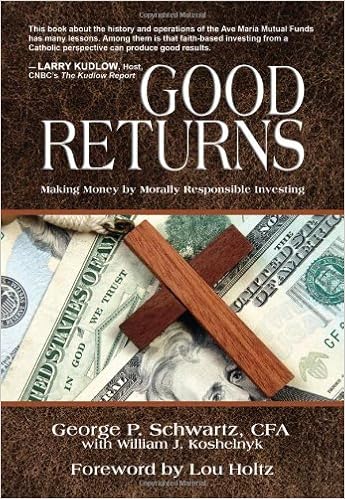
Morality and Investing


About the Book:

Offering time-tested wisdom on the complexities of the investment process, this guide provides advice on how to invest in a morally responsible way. It provides information on how to screen and exclude companies according to a clear set of faith-based criteria: those who support or service the abortion industry, producers and distributors of pornography, and companies involved in embryonic stem cell research. Based on this set of guidelines, as well as the success of the Ave Maria Mutual Funds, the guide demonstrates that high returns are achievable without supporting companies that do not support similar values. Also included is insightful commentary on the current political policies affecting the country’s financial state.

My Comments:

Good Returns: Making Money by Morally Responsible Investing is written by the founder of the Ave Maria family of mutual funds.  The Ave Maria funds practice what they call morally responsible investing--they do not invest in companies that promote abortion or donate to its supporters, sell or promote pornography or which have policies supportive of homosexual or other non-marital sexual unions.  He contrasts "morally responsible investing" with "socially responsible investing" which generally supports left-leaning causes. 

While this is a book about investing and the economy; not about religion, the author, George Schwartz, does quote papal writings on the economy and a little scripture.  He sees free-market capitalism as a moral good and socialism as a moral evil.  The book is definitely pro-Regan, anti-Obama. 

Good Returns: Making Money by Morally Responsible Investing has its good points, and its weaknesses.  The first chapter, on money and morality is excellent.  The next two chapters were about Schwartz himself, and frankly, I wasn't that interested.  He then spends a couple of chapters talking about his investment principals, and about how investors think.  Those chapters were good.  Chapters 6 and 7 are highly political; my husband will love them.  They do serve the purpose of reminding the investor how politics affects the economy, for good and for bad--and how even good intentions, like  providing home ownership for those kept out by traditional lending practices, can have bad effects--like the housing bubble and its subsequent pop.  Chapters 8-11 are, in many ways, commercials for the Ave Maria funds. If you know nothing about investing or financial planning, there is good information there--and even those who read investment books may learn something about investing that they can use, even if they never buy Ave Maria mutual funds.

While most of us want to follow our values, most of us also invest with the idea of making money.  One question that came to my mind after reading this book was "How well do Ave Maria funds do?".  Ave Maria has a Rising Dividend fund which outpeformed the S&P 500.  Morningstar give it four stars and the expense ratio is 0.92%.  Their Growth Fund has also outperformed the S&P 500.  However their Values Fund and World Equity Fund trail their indexes.  Still, I don't think any of them are really bad investments and I do like the idea of investing in companies that share my moral values.  


brokeGIRLrich