Showing posts with label peer-to-peer lending. Show all posts
Monday, May 29, 2017
Returns on My Prosper Account
I have money invested with two different Peer-to-Peer lending companies, Lending Club and Prosper. My Lending Club returns were discussed in an earlier post, which also described the concept of Peer-to-Peer Lending. Now I am reviewing my Prosper account.
Am I Making Money With Lending Club?
I have been investing via Lending Club since July, 2014, or for almost three years. If you check out my other Lending Club posts, one thing you will notice is that my returns have steadily decreased. It is time to take another look at whether I am making money with Lending Club.
What is Lending Club?
Lending Club is a "peer-to-peer" or marketplace lender. People who want to borrow money apply with Lending Club, which then reviews the application and, if it approves the loan, assigns an interest rate. Then, instead of giving borrowers its own money, Lending Club makes the loan available either to institutional investors or to individual investors via its website. Investors can invest in as little as $25 per loan, and Lending Club advises retail investors (us normal folks) to diversify--to invest in a lot of loans for a little money rather than a few for a lot.
As borrowers repay loans, investors have their principal returned, along with interest. It is expected that some borrowers will not repay the loans in full and the chance of that happening is supposed to be reflected in the interest rates charged.
What Return is Expected With Lending Club?
When deciding to invest, most people want to know what the expected return is, on average. We've all heard about how if we had only invested a few dollars in facebook or Amazon all those years ago, we'd be rich now. However, over the long run, history has shown that on average stocks return about 7-8% per year.
This chart provided by Lending Club shows that my adjusted return, which takes into account a hypothetical write-down for past-due notes, is about 5% and that for accounts the age and size of mine that invest in notes with the interest rates I've chosen, I'm doing about as well as can be expected. Peter Renton is considered to be a Peer Lending expert and his experience is similar to mine.
These charts from the Lending Club website show that, as things stand now, getting more than 7% or less than 3% is difficult if you have over about 300 notes, and that most people should expect returns of about 5%. When I posted on his subject two years ago, the norm from which it was hard to stray was 8%. Clearly something has changed.
How Am I Doing With Lending Club?
According to the charts shown above, if you take anticipated defaults into consideration, my net annualized return is 5.67%, which doesn't sound too bad. However, the figure is somewhat misleading.
First of all, the figure reflects the life of the account, not current conditions. If the average interest rate of my notes is 20% and the first month all the borrowers pay, then my net annualized return is 20%. As borrowers stop paying the net annualized return falls but it takes some time for it to stabilize even assuming that both the interest rates and the default rates remain constant, which they do not. Put simply, the return for this month is likely to be much lower than the return for month one, but the NAR averages them, and all the other months during which the account has been open.
Another problem with the NAR is that it does not account for "cash drag", for money that has not been invested in a note yet or which has been invested in notes that are still being processed. If you look at the chart above, you'll see that I have $166 that is not currently earning interest and because of the way Lending Club is constantly returning both principal and interest, that figure is pretty close to what it is most days. To Lending Club's credit, they have decreased processing time so that figure is lower than it was a year ago.
A method of computing returns that takes into account "cash drag" is XIRR and a calculator is here. Using this calculator, my returns are 5.54% since the inception of the account. A year ago that figure was 6.75%. While this gives me a good picture of the account over its lifespan, it doesn't tell me how things are going right now.
On December 31, the adjusted value of my Lending Club account was $19,804.36. Since that time I've withdrawn $2712.66 because we needed the money. My adjusted value is now $17273.72, giving me returns of $182.02 so far this year. If you annualize that, you get about 2.55% per year. While I'm not losing money, I'm clearly not getting rich.
What Will Happen in the Future?
Who knows? Lending Club has increased rates several times in the last year so hopefully that will help overall returns. On the other hand, if we enter a recession and unemployment increases, defaults likely will too.
What Are My Plans for My Lending Club Account?
Right now, my plan is to hold the course. If we need to withdraw money from an investment account for current needs, getting over $1000 per month for a few months is easy and penalty-free. If my current returns do not increase in another year or so, I will probably move this money into the stock market.
Friday, November 4, 2016
Prosper versus Lending Club: My Results
Prosper and Lending Club are both "marketplace" or "peer-to-peer" lenders. Both allow people who want to borrow money to apply online. Both allow small investors to buy portions of many loans and both make their money on application fees and servicing fees. As an investor it is important to look at the differences between the companies before investing your money. In the battle of Lending Club versus Prosper, who wins?
Friday, May 13, 2016
My Lending Club Portfolios
Lending Club allows you to divide your notes into "portfolios" or groups of notes and it shows you data about those portfolios. This post is about my Lending Club portfolios--what they are, why I invested that way and what my results are.
I purchased all the notes in this portfolio new in 2014 and 2015. I used a lot of different criteria and tried to track them for a while but just gave up. It is the largest of my portfolios. I have lost 31% of the interest earned because of loan charge-offs.
This portfolio is made of all the notes I purchased in 2016. I have invested no new money in this account; all of these notes were purchased with the principal and interest paid to me each day. As of May 8, an account of about $19,000 has paid me over $4,000. That's a handy number to keep in mind if you want liquidity in an investment. Lending Club notes are not instantly liquid (though they can be sold on a secondary market) however, they regularly throw off cash, which you can choose not to reinvest. I use Lending Club's automatic investment feature to purchase equal numbers of C, D, and E rated notes. I filter the notes to get only those for debt consolidation or credit card payoff and to eliminate those where the borrow has other credit inquiries in the last six months. Lending Club projects that my return will be 7.38% annually. So far, none of these notes is late.
Lending Robot is a service you can use to pick notes for you. They will invest a certain amount at no charge; after that, they charge a percent of the money they invest for you. The advantages to Lending Robot are speed and its algorithm. Lending Robot's computers are able to log onto Lending Club's site, filter the available loans and select and purchase appropriate ones more quickly than even Lending Club's automatic investing system. If you are trying to deploy a large amount of money at one time, it can make a real difference. Also, Lending Robot and similar services crunch all the numbers on all the loans made by Lending Club and try to find weaknesses in Lending Club's underwriting. In short, they are trying to find loans which Lending Club overpriced--loans that are less likely to default than others with the same interest rate. If you invest via Lending Robot you can use your filters or theirs. This portfolio was designed by and picked by Lending Robot. I have lost 33% of the interest gained on this portfolio to charge-offs.
Peer to Peer Quant was a website that purported to have a system for picking notes that were less likely to default and therefore would earn higher returns than other similarly-rated notes. The owners decided to shut it down, and said the returns were not enough better than average to justify keeping it. Interestingly, I have only lost 13% of my interest to defaults.
This is another Lending Robot portfolio. I have lost 30% of my interest for this portfolio.
When I first started researching Lending Club I read articles that said that most defaults at least get started in the first year of the note's life. The borrower will be late for a payment, even if he later pays on time for a while. The borrower's FICO score will go down. The writer of what I was reading recommended buying high-interest notes that were at least a year old and which had perfect payment records. He also recommended avoiding those whose borrowers had FICO drops. The problem with such notes is that the owners generally know they have something of value, and charge a premium for it. When I bought these notes, I generally paid a premium with the attitude that if I made money, I had not problem with the first owner doing so as well. Unfortunately, I found that early pay-offs of these loans were not uncommon, and at 39%, this is one of the portfolio where defaults have taken the biggest chunk of my interest.
Another article I read early on talked about a "penny notes" strategy. He recommended buying A or B notes with about a year left on them. It was his opinion that these were very unlikely to default. Since I was not sure about Lending Club, I liked the idea of getting my money back quickly in case I wanted it for something else. As you can see, there are 213 notes in this portfolio and 101 have been paid off completely. Seven have been charged off, so I have lost 39% of my interest to defaults so I don't think this turned out to be a "safe" way to invest.
Do you invest via Lending Club? What are your returns?
Sunday, May 8, 2016
What I Am Really Earning Via Lending Club
When I first heard of Lending Club, I searched high and low to find out how real people were doing with it. Can you earn a lot? What are a real person's Lending Club results? I have now been investing via Lending Club for about two years and want to let you know how much I earn from Lending Club.
First, let's look at what Lending Club says I earn:
If you are not familiar with Lending Club's dashboard, let me use this time to explain this. You can see on the left that "primary notes" and "traded notes" are grey'd out. This means that my account contains both notes I purchased new and kept, as well as notes I either purchased from or sold to another user (I've done both). That 10.07% figure assumes that all notes not currently in default will pay the full amount owed on the date owed, an assumption that everyone knows is not true. Further, it does not take into account that you always have money in your account that is not earning interest. If you look at the chart above, at the time that screenshot was taken, I had $1.50 that was totally un-invested and $225.00 that was committed to notes but not yet invested, meaning that it was earning no interest.
On the right side of the chart you can see that during my time with Lending Club I have purchased 1330 notes, or parts of loans. Of those, 9 are still being processed (and aren't earning me anything); 971 are current and paying, 8 are in grace period (less than 15 days late), 4 are between 16 and 30 days late, 32 are over 30 days late and 55 have been charged off as worthless (though Lending Club does sell them to a debt collector and will credit your account a little when that happens).
As I said, the first figure assumes that all borrowers will pay as promised, and that everyone knows that isn't going to happen. This second figure shows Lending Club's estimate of what is more likely to be true. Their experience has shown that 10% of the value of notes which enter grace period is lost. Obviously, that is on an aggregate basis, not an individual one since most end up paying, just late but those few that don't are the reason for the drop. Based on the number of late notes currently in my portfolio, Lending Club estimates the real value of my account to be $557.80 less than shown in the first figure and estimates that my rate of return is 7.49% rather than 10.07%. However, even that figure is inflated as it does not take into account the cash drag--the money in my account that is not earning anything. Today's figure of $225 is pretty average; some days it is more (like if several people decide to pay off loans) and some days it is less.
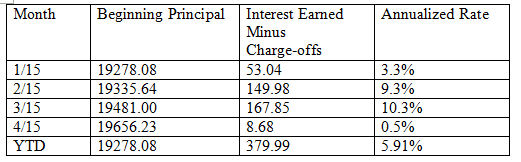
So, what am I really earning, and how do I compute it? Well, one way that works well, if you are not adding principal to the account, is looking at the principal at the beginning of the month and the amount of interest earned that month, minus what you lost to defaults, and annualize the results. Lending Club sends out statements monthly, using the actual rather than adjusted figures. Here are mine for the last few months:
If you are adding or withdrawing principal, the XIRR method is considered the most accurate. You can use Excel to compute this (but don't ask me how) or you can use this online calculator. Using the adjusted values, it shows my returns to be 6.75%; using unadjusted values, my returns are 9.02%. In either case, this far exceeds my stock market returns during the same time. My account has grown from $17,050 to over $19,000. Why are the XIRR results so much higher than annualizing monthly returns as above? Because the first few months the returns are artificially high as defaults have not started to hit yet. For example I have one portfolio in which I keep all the notes I have purchased this year (2016). As of today, May 8, all are current; none are late. As these notes age, and some quit paying my overall return on that group of notes will fall.
One thing Lending Club allows you to do is to divide your notes into "portfolios" and to therefore track different portfolios. My next post will talk about my Lending Club portfolios.
Friday, March 4, 2016
5 Ways to Invest Your Tax Refund
It is always tempting to take a windfall and spend it on something fun, but if you are approaching retirement (and all of us should consider ourselves to be in that boat--just with different finish lines) investing at least part of it is a smart money move. Here are some options.
If you are investing adequately to meet your future goals, then spending a windfall on fun isn't necessarily a bad idea; however if you are behind on your retirement savings, you'll spend a lot more time wishing you had more money than you will spend at Disneyworld with your tax refund.
- Peer to Peer Lending: If you have at least $2,500 dollars to invest, Peer to Peer Lending via Lending Club or Prosper offers returns between 5% and 8% annually, with decent, though not instant liquidity. You can read my posts about Peer to Peer Lending here. Statistics going back before the bear market/recession of 2008 show that less that 1% of people who have invested in at least 100 notes at $25 each have lost money.
- Kickfurther: Kickfurther is a platform by which investors finance inventory for businesses by purchasing that inventory and returning it to the company to sell on consignment. When the inventory sells, investors receive an agreed-upon return. There are two risks. The first is that the inventory doesn't sell. If that happens, the investors can vote to repossess the inventory and try to sell it in some other way to recoup their investment. The second is that the business will sell the inventory and then use the money to pay the rent, and not have enough to pay investors. The advantage of Kickfurther is that you can invest as little as $20, and most offers are for much less than a year, and once the repayment term starts, payments are supposed to be made monthly. I've been investing in Kickfurther for about a year and at this point I would classify it as a relatively high risk/high return investment. Click here to get $5.00 towards your first investment.
- Motif: If you want to try the stock market, Motif is an interesting concept. For one sales commission of $9.95 you can purchase one "motif" or group of stocks. Motif has a wide selection of company-designed motifs, and it allows investors to design their own motifs and market them to other investors. Most motifs have a theme, just as "Growing Dividends" or "Video Gaming" and the stocks in the motif reflect that theme. I have written about Motif before. If you invest via this link, we both get $100.
- Loyal3: Another option, if you want to pick stocks, is Loyal3. While they only offer the stocks of about seventy companies, all trades are commission-free, and you are allowed to buy fractional shares. This means you can use Loyal3 not only to invest a substantial sum, but also to purchase a few dollars with of stock on a weekly or monthly basis. I'm using Loyal3 to invest the money I save by not eating out at lunchtime. Read about my investments.
- Mutual funds: For people who don't really want to learn about the stock market or how to pick stocks, mutual funds allow you to outsource that job to either a professional or a computer. With mutual funds, the money of many investors is pooled, and investments purchased. If the investments increase in value, the price of the shares goes up; if the value of the investments falls, so does the share price. While there are a lot of flavors of mutual funds they are basically divided into index funds, which purchase shares of stocks or bonds to mimic one of the indexes and actively managed funds which have a manager who, following the policies laid out for the fund regarding the types of investment it makes, buys and sells investments trying to beat the market as a whole. Few succeed long-term. All cost more than index funds. One of the best place to get index funds or low-cost actively managed funds is Vanguard.
Friday, February 19, 2016
My Peer Lending Accounts: February 2016
If you are going to be a financial blogger, you have to decide how much of your financial information you are going to make public. On the one hand, I know that when I read blogs, I like to see people with whom I can identify. To me, it seems like it would be easy to save money if you have income that is twice mine (though I know that many people in that income bracket have expenses that are twice mine as well). Also, if you are going to tell me how I should invest my money, I'd like to see some evidence that you are successful at managing yours. On the other hand, I'm not comfortable spilling all the information about my income and net worth. To that end, I've decided that there are certain investments about which I will be writing. I'm going to give you some idea of how important they are to me, and will detail my earnings and losses. On other investments I'm going to talk about percentages. My Peer-to Peer Lending accounts are accounts on which I'll be making full disclosure. As to how important these accounts are to my net worth, I'll just say that these accounts are our next two cars (we buy used). Losing every penny might not be catastrophic but it would definitely hurt.
What Is Peer-to-Peer Lending?
My Investments:
Prosper:
I put $5,000 in Prosper at the end of 2014. I added $5,000 each on February 16 and March 23. On January 30, 2016, I deposited $300. As of February 9, 2016, the account is worth $17,005.97, meaning that in a little over a year, I have earned $1705.97, which has all been reinvested. This portfolio has always been auto-invested using tools on Prosper's website. About 1/3 of it is in A and B rated loans. According to Prosper, my annualized return is 13%. However, right now I have thirty-nine late notes; the question is how many of them will default. Prosper does not publicly predict this. Rather, Prosper breaks down your return by "All Notes" and "Seasoned Notes". Experience has shown that most borrowers who default do so relatively early in the life of the note. Prosper considers notes to be "Seasoned" by 10 months; after than, in their experience, returns stabilize for a given vintage and do not drop quickly or significantly. My seasoned returns are $13.41% because my early purchases did not include A and B notes. To put that number in perspective, the average yield of my notes at acquisition, in other words, not accounting for defaults, was 17.09%.
Lending Club:
Lending Club was my first foray into Peer-to-Peer Lending. I've done a lot of different things within this account, frankly to the point that I've lost track of some of them. Some of the notes were purchased to attempt to get a high yield. Some were purchased with safety in mind. Some were new when purchased; others were bough on the resale market. In total, I invested $17,550 between July, 2015 and March, 2015. Lending Club shows you two different rates of return. The first is the rate that is comparable to Prosper's--a rate that does not penalize you for late notes until those notes are actually charged off. As of February 9, 2015, that rate is 10.76%. Lending Club also offers an "adjusted" rate of return, which writes down late notes by various percentages based on how late they are. It is a hypothetical return--the write down doesn't actually happen, but it is supposed to give you a more realistic view of your likely returns. My adjusted rate of return is 7.93%. My current account value is $19,405.45, which is adjusted to $18,919.69.
Returns:
It is difficult to get a number to use to compare Peer-to-Peer results with other investments. When I buy stock, 100% of the money I invest in that stock goes into that stock (minus any sales commission). It stays there until I sell the stock. I may also get dividends. When I sell the stock, I know how much I made (or lost) and how long I owned the stock. While I may move in and out of the market, it is not something that most normal people do multiple times daily. With peer-to peer lending, I invest a sum of money. Once it hits the account, I select notes in which to invest--either manually, or using one of the automated systems. Depending on how much money I want to invest and how many loans are on the platform that meet my criteria, it can take one day or many to totally invest the money. However, once the notes are chosen, it may take up to ten days to complete the funding process, or either the platform or the borrower may decide not to complete the loan. If that happens, then the money I invested has to be re-invested in another note. It took me over a month to completely invest $5,000 at $25 per loan. Interest does not start accruing until the borrower has the money. Once the borrowers start paying, the platforms take 1% as their fee. Also, late fees can be collected, and of course, some borrowers quit paying and the notes are lost. Finally a lot of notes are paid off early. When the notes are paid, the money received is not earning interest until it is re-invested. As of this writing, I have about $400 in uninvested cash and committed to notes which have not been finalized in Lending Club, and I'd say that's a pretty average figure for me. This phenomenon which is referred to as "cash drag" means that even though Lending Club says my return is 7.93%, it is actually less than that because a certain amount of money is earning no interest at any given time. Despite the difficulties, there are several methods people use to compute returns:
Using the platform figures:
This is the easy way. While it does not take into account uninvested cash, it is accurate as far as the notes themselves go and it gives you a benchmark to compare to the platform. The "seasoned" returns for Prosper and the "adjusted" returns for Lending Club are more accurate than the gross figures.
Computing the difference and annualizing it:
If you are not adding to or subtracting from your account regularly, this method is easy. Simply review your monthly statement and see how much more (or less) money you have at the end of a period than at the beginning, and then annualize that number. My Lending Club figure, computed from March forward (since that is the last time I contributed money) is 10.22% and that does not account for late notes. For Prosper is is 11.54%.
XIRR:
This is a mathmatical computation that can be done on spreadsheets with the right formula or can be done online here. It views the account as a whole and takes into account money that comes into the account and goes out of it. Depending on the final value you assign the account, it can take into account your likely losses on late notes. For Lending Club, my XIRR return is 7.24% using the adjusted value of my account and 10.11% using the actual value. For Prosper, the return is 11.71%
Conclusion:
In short, for accounts with no principal infusion for eight months, my XIRR returns are about 1% less than the returns quoted on the platforms. Nevertheless, over the last year, this has been my best performing investment.
Should You Invest?
Maybe. In some states, those who invest in peer-to-peer notes are required to have at least $70,000 in investable assets. I've read that it is recommended that no more than 10% of your investable assets be in peer-to-peer lending. I've also read that the best way to protect against substantial loss is to diversify, meaning to purchase at least 100 notes. Prosper claims that since July, 2009, no one who has purchased at least 100 notes has had a negative return (Prosper's system was vastly different prior to July 2009). Lending Club states that historically, less than 1% of those who have invested in at least 100 notes have had a negative return. If you have few investable assets, peer-to-peer lending is too new and too risky for you. On the other hand, if you have $2,500 or more that you can afford to lose, Lending Club and Prosper offer the possibility of returns far higher than bank accounts (with much more risk), and because of the monthly payments made by the borrowers, they can be set to return substantial cash to investors relatively quickly. For example, between January 1 and February 9, my account has paid over $1,600 to me in principal and interest. While I've reinvested it, I could have withdrawn it if I needed it.
How to Invest?
I would recommend going to either Prosper or Lending Club, opening an account and investing $2,500. Use that money to purchase 100 notes spread over different risk levels using the auto-invest feature. Then, sit back and watch. See how defaults affect your returns. Watch the interest accrue. Read articles about filtering and check out some sites that do it for you like NSR invest or Blue Vestment. Decide going in that you are going to leave your money there for at least a year, and that the money you invested is money you can afford to lose. After a year, review the situation. While most people find that the higher potential return of C, D, and E notes makes them a better investment than A and B notes, others hate the idea of loss of principal and so prefer to stick with less risky notes. After a year you should be in a position to move your portfolio toward your preferred risk/return profile.
I have found peer-to-peer lending to be a valuable addition to my portfolio and believe it is appropriate for many people; however, I am not a financial adviser, and realize that no investment is right for everyone. Use your own best judgment; no one cares about your money as much as you do.
Thursday, October 29, 2015
How to Pick Lending Club Notes
Lending Club is a Peer-to-Peer lender. Investors are able to review data regarding people who want to borrow money and have to select the borrowers to whom they want to lend. When Lending Club started, potential lenders were able to question potential borrowers about their needs and plans for the money. As the platform grew, that feature disappeard. Now, investors can see a collection of data points about the borrowers, but there is no personal contact and the information is vague enough that your best friend could have an application on the platform and you would not recognize it unless you knew it was there (and probably not even then).
I am writing this article on a Saturday night (yes, I lead an exciting life) and as of this moment, there are 1175 loans looking for funding, probably one of the lower numbers of the week. There are over 200,000 resale notes available. How do I decide in which notes to invest?
Read the Listing, Select the Note:
This is the old-fashioned way to do it, and some people swear by it. However, as the listings today are a set of data points, I don't know how you get any "feel" for the borrower by doing this. While it may make control freaks feel better, it is time-consuming.
Use Lending Club's Automated Investing:
Lending Club offers an automated investing feature. Investors either select one of three targeted returns (A&B Weighted, Platform Mix or D-G Weighted) or select their own mix, push the button and let Lending Club select the notes for you. If you choose to select your own mix, you can determine what percent of your notes should be from which rating and you can use any filters you want to use.
Use Lending Club's Note Browser to Filter and Select Notes:
If you click on Browse Notes on the Lending Club Homepage, there is a filtering mechanism on the left-hand side. If you don't want to lend to anyone who has had any delinquicies in the last two years, you can filter out those borrowers. If you want to lend to people who are paying medical expenses, you can filter them in and everyone else out. It is up to you. Once you have your filters set, you can save them to run again, or to use with automated investing.
It is Lending Club's goal to assign the same interest rate to loans that share the same risk of default. If you filter beyond saying that you want a particular grade of note, you are basically saying that you think you are smarter than Lending Club. You are looking for notes that aren't as riskly as Lending Club thinks they are. NSR Platform can help you back-test potential filters, however, Lending Club is running the same kinds of tests, and adjusting their underwriting when they find a discrepancy. That isn't to say you can't find a filter that could help; only that it won't be easy.
This method offers the advantage of personal control--you see each note before you invest and can decide not to invest if anything looks "off". It is more efficient than looking at 1100 notes to select 5. You can start with broad criteria and keep adding filters until you get down to a number of loans you are willing to review.
Use A Third-Party Service to Pick Your Notes
The main advantage to Lending Club's Automatic Investing feature is its cost--free. However,it does not make any attempt to beat the average, and people say it goes for the leftover notes, it does not push to the front of the line for the "good" ones. Third-Party vendors use Lending Club's API (don't worry if you don't understand it; they tell you how to set it up) to purchase notes for your account, and they do push you to the front of the line, so to speak--their computer fires up when Lending Club releases a new batch of loans and quickly selects the ones it wants for your. They also try to select what they think are the best loans. While most of the services offer a certain number of free picks, their goal is to get you to pay them a small fee per note for their help. Some of these services are:
NSR Invest
NSR Invest is for people with more than $5,000 to invest and they will fully manage your account (if you want) once it exceeds $10,000. They start charging when the account exceeds $20.000 and they charge 0.6%.
Peer to Peer Quant
Peer to Peer Quant uses computer modeling to select the notes it believes will give you the highest returns. As I am writing this, there are about 1100 notes available on Lending Club; 225 appear on their platform. Those notes are all C, D, and E level notes, except one F. That is in keeping with Lending Club's published statistics what show them to be the top performers. There are 629 C, D and E notes available as of this writing, so Peer to Peer Quant has decided that 225 of them are better than the others. They have been using their system since July, 2014 and claim a return of 10.3% in the last twelve months. If you check Lending Club's Loan Performance Details chart you'll see that for loans issued between the third quarter of 2014 and the second quarter of 2015, the annualized return was 9.5% for C's, 10.9% for D's and 9.69 for E's. That does not take into account the cash drag that Peer to Peer Quant's return does.
To use Peer to Peer Quant's service, you create an account. Their website then gives you a list of what they consider to be the best currently available notes, and recommends that you start at the top of the list and work your way down, in order, until your money is spent. You select the notes you want and how much money you want to invest in each. The notes are then purchased and put in your account. Peer to Peer Quant gives users five free selections each month so you can kick the tires to see if it works for you. I have an account with them. I have invested $1146.71 (they recommended secondary market notes for a while and I tried some of them) in 51 notes. The weighted average rate on those notes is 16.35%. I lost $24.44 when one of the notes charged off. All the others are current. Two have been fully paid. I have earned $83.33 in interest, which is about 7% of the amount invested. If you subtract the money lost to the default, my return to date (gross, not annualized) drops to about 5%.
Lending Robot (that's an affiliate link, and I get some free picks if you use it) has several models from which you can choose, or you can design your own filters. Their advantage is speed. Lending Club posts new loans several times daily, and those considered desireable by many people are filled almost immediately. Lending Robot gives you the ability to grab those loans. When you are trying to invest a large sum of money a speedy tool like this can get you invested (and earning interest) much sooner than any manual method and even faster than Lending Club's Automatic Investment. The first $5,000 they invest for you is managed for free. You can earn additional sums to be managed free by getting folks to invest via affilliate links like this one. The rest of the money is managed at a rate of 0.45% per year. On a $15,000 account, that is about $3.75 per month.
I have an account with Lending Robot. I invested in their Credit Refinance portfolio and in their Popular Loans portfolio. 1.3% of my notes in Credit Refinance have defaulted. 4% are currently late. My weighted annual interest rate is 18.16%. So far I've earned interest worth 9.3% of my principal. If you subtract the principal I've lost, and the amounts Lending Club estimates I will lose on my late notes, my return so far is 6.2% of what I invested. That's not really an APR because each month when payments are made, the money leaves this pot since I'm no longer using Lending Robot to reinvest. Another way to look at it is that these notes are 14% of the notes I own and 15% of the defaults.
Peer Cube
Peer Cube has a lot of statistical information and offers a collection of filters with expected results. They also have a paid plain for which they chare $19.95 per month and they will automatically invest your money.
The services above are all new enough that they do not have a long-term track record that could be compared against just buying the platform.
How do you pick your Lending Club (or Prosper) notes?
An Analysis of My Lending Club Account
Lending Club is a marketplace lender. Investors can purchase shares of loans which are made to ordinary people, and receive the interest paid by the borrowers, minus a processing fee. Unfortunately, if the borrower does not pay, the lender, not Lending Club, loses money. Fortunately, the interest rates seem to be set so as to give most investors about an 8% return on their money after bad loans are subtracted.
Lending Club allows investors to purchase shares in newly approved loans, or to purchase shares that other investors, for whatever reason, no longer want to keep. The resale market is based on supply and demand; the owner of a note can ask whatever price is desired; whether or not it is purchased is up to a buyer. I have been investing in both new and resale notes for over a year now, and the defaults are starting to hit. I decided to take a look at my portfolio, analyze it, and share the results with you.
Right now, Lending Club says I have a net annualized return of 14.13% on the notes I bought new. However, if you mark down the ones with delinquent payments at the amount Lending Club has found to be accurate in the past, that drops to 10.57%. On the resale notes, my net annualized return is 8.01%, which adjusts to $4.74%. The total for my portfolio is 11.98%, adjusted to 8.53%.
As of this moment, I have 1074 notes. 407 were resale notes. About 4.2% are not current and about 1% have been lost after a year. One thing many of the blogs I read about Lending Club said, and which Lending Club's statistics tend to confirm, is that the greatest risk of default is in the first year. In general when I buy resale notes, I buy notes that are at least a year old.
526 of my notes were for 36 month loans; 555 were for 60 month loans.
Of the 667 new notes, 3.9% are not current and about 2% have been lost after a year. My overall return is higher on the new notes than the resale notes because I bought a lot of low-risk resale notes when I first started investing.
I have 123 "A" notes. 60 were purchased new; the rest were resale notes. All the resale notes are current or paid off. Of the new ones, two are 1-15 days late. Thirteen"A" notes are paid off, two were new.
I have 168 "B" notes. 34 were purchased new, the rest were resale. Two have been charged off, and they were both resale notes. Three are 1-15 days late. Three are 31-120 days late. All the late notes were resale notes. 51 have been fully paid; only three of those were new.
I have 242 "C" notes. 171 were purchased new, the rest were resale. Of the six that are late, one is new, the rest resale. Four "C" notes were charged off, of them one was a resale note. 22 have been fully paid; of those 8 were new.
I have 239 "D" notes. Of those, 209 were purchased new. Three "D" notes have been charged off and two are in default (they usually only spend a few days in this category before being charged off). All were new. 10 are late and of those, only one was a resale note. 22 have been fully paid and 13 of those were new.
I have 215 "E" notes. Of those 33 were resale notes. Seven notes are late but as of this writing, no "E" notes have been charged off. 15 have been fully paid; of those 8 were resale.
I have 45 "F" notes. Of those, 17 are resale notes. One was charged off and it was a resale note. Three are late; one of which is a resale note. Four have been paid off, three of which were resale.
I have 31 "G" notes. Of those 16 are resale notes. one has been charged off, and it was new. Two are late, one new, one resale. Three have been paid, one of which was resale.
My conclusions? While roughly 40% of my notes are resale notes, 45% of my grace period (late 1-15 days) notes are resale notes. 40% of the other late notes were resale. 36% of the default/charged off were resales. However, while roughly 40% of the notes were resale, they only represent about 30% of the money invested. The defaulted resale notes accounted for 29% of the principal I lost due to defaults. While I bought resale notes with the hope that I would lose less money to default, that doesnt' seem to be happening. Since Lending Clubs fees hit you a lot harder at the end of the loan than the beginning, I do not think the ones I have been buying have been helpful to me.
*Part of Financially Savvy Saturdays on brokeGIRLrich, A Disease Called Debt and Shoeaholic No More*
Lending Club allows investors to purchase shares in newly approved loans, or to purchase shares that other investors, for whatever reason, no longer want to keep. The resale market is based on supply and demand; the owner of a note can ask whatever price is desired; whether or not it is purchased is up to a buyer. I have been investing in both new and resale notes for over a year now, and the defaults are starting to hit. I decided to take a look at my portfolio, analyze it, and share the results with you.
Right now, Lending Club says I have a net annualized return of 14.13% on the notes I bought new. However, if you mark down the ones with delinquent payments at the amount Lending Club has found to be accurate in the past, that drops to 10.57%. On the resale notes, my net annualized return is 8.01%, which adjusts to $4.74%. The total for my portfolio is 11.98%, adjusted to 8.53%.
As of this moment, I have 1074 notes. 407 were resale notes. About 4.2% are not current and about 1% have been lost after a year. One thing many of the blogs I read about Lending Club said, and which Lending Club's statistics tend to confirm, is that the greatest risk of default is in the first year. In general when I buy resale notes, I buy notes that are at least a year old.
526 of my notes were for 36 month loans; 555 were for 60 month loans.
Of the 667 new notes, 3.9% are not current and about 2% have been lost after a year. My overall return is higher on the new notes than the resale notes because I bought a lot of low-risk resale notes when I first started investing.
I have 123 "A" notes. 60 were purchased new; the rest were resale notes. All the resale notes are current or paid off. Of the new ones, two are 1-15 days late. Thirteen"A" notes are paid off, two were new.
I have 168 "B" notes. 34 were purchased new, the rest were resale. Two have been charged off, and they were both resale notes. Three are 1-15 days late. Three are 31-120 days late. All the late notes were resale notes. 51 have been fully paid; only three of those were new.
I have 242 "C" notes. 171 were purchased new, the rest were resale. Of the six that are late, one is new, the rest resale. Four "C" notes were charged off, of them one was a resale note. 22 have been fully paid; of those 8 were new.
I have 239 "D" notes. Of those, 209 were purchased new. Three "D" notes have been charged off and two are in default (they usually only spend a few days in this category before being charged off). All were new. 10 are late and of those, only one was a resale note. 22 have been fully paid and 13 of those were new.
I have 215 "E" notes. Of those 33 were resale notes. Seven notes are late but as of this writing, no "E" notes have been charged off. 15 have been fully paid; of those 8 were resale.
I have 45 "F" notes. Of those, 17 are resale notes. One was charged off and it was a resale note. Three are late; one of which is a resale note. Four have been paid off, three of which were resale.
I have 31 "G" notes. Of those 16 are resale notes. one has been charged off, and it was new. Two are late, one new, one resale. Three have been paid, one of which was resale.
My conclusions? While roughly 40% of my notes are resale notes, 45% of my grace period (late 1-15 days) notes are resale notes. 40% of the other late notes were resale. 36% of the default/charged off were resales. However, while roughly 40% of the notes were resale, they only represent about 30% of the money invested. The defaulted resale notes accounted for 29% of the principal I lost due to defaults. While I bought resale notes with the hope that I would lose less money to default, that doesnt' seem to be happening. Since Lending Clubs fees hit you a lot harder at the end of the loan than the beginning, I do not think the ones I have been buying have been helpful to me.
*Part of Financially Savvy Saturdays on brokeGIRLrich, A Disease Called Debt and Shoeaholic No More*
Friday, September 25, 2015
Evaluating Your Investments: Income- Focused Investments
Someone once asked my why I invested in a particular thing. My answer? "To make money, of course". That answer was the truth but the point of the question was that there is no perfect investment; they all have strengths and weaknesses and when evaluating a new investment or deciding how to allocate your money among investments you have, you have to consider the strengths and weaknesses of each type of investment. This article will focus on investments that people buy for income--for money paid to them now, whether that money is to be used now or reinvested for future use.
Types of Accounts
First we need to quickly look at the basic types of investment accounts. Most types of investments can be held in any of these types of accounts. Which you pick depends on your current and future needs.
Normal Accounts
These are opened by default; the others must be chosen. Income from normal accounts is taxed yearly. While the custodian of the account may have rules governing withdrawals, the government does not. The advantage of these accounts is that you can get your money when you want it. The disadvantage is that you can get your money when you want it--and that you have to pay taxes yearly.
![]() |
| Used with permission of 401kcalculator.org |
Roth IRA
Once money is placed in a Roth IRA you will never pay taxes again on it again or on the money it earns. However, contributions are not tax-deductible when made. What's more, you can withdraw your contributions (but not your earnings) at any time without penalty. Some people use Roth IRAs to save for medium-term goals; they withdraw principal when needed but the earnings stay to grow, and grow tax-free. Another feature of the Roth IRA is that you never have to withdraw money from it; the account, and its tax-free status, can be passed on to your heirs.
IRA or 401K
You do not pay taxes on money you put into these accounts. However, unless you are over 59.5 years, you pay penalties if you withdraw money. Also, you have to pay income taxes on any money withdrawn from your IRA or 401K. Finally, the law requires people over 70 to take minimum distributions from their IRA or 401K, based on age/life expectancy.
Types of Investments
This article focuses on investments people hold for the income they generate.
Bank Accounts
Description: Very simple. Take your money to the bank and deposit it. They agree to pay you very little interest but your account is insured by the government and except for certificates of deposit, you can access your money at any time without penalty.
Liquidity: Bank accounts can be accessed at any time.
Stability: The value of bank accounts is predictable and they are insured by the government so you know they will not lose value.
Growth Potential: After taxes, bank account earnings do not keep up with inflation, much less exceed it.
Taxes: Interest on bank accounts is taxed as regular income.
Conclusion: Bank accounts are for money you may need to access on short notice, or which you have a specific plan to sell in the next year or two.
| From Wikimedia Commons |
Bonds
Description: Bonds are debt instruments issued by corporations or governmental entities. When you buy a bond, you are lending money to that entity. In return the entity agrees to pay you interest, usually yearly. and to return the principal at the end of the term of the bond. Generally speaking the more financially stable the issuer is, the lower the interest rate. Generally speaking, the longer the term of the bond, the higher the interest rate.
Liquidity: Bonds can generally be sold relatively quickly (unless the entity that issued them is having financial trouble), but you may not receive full value for them.
Stability: It depends on the bond. Generally speaking, as long as the issuer is able to make the payments, the bond will be worth at least what you paid for it, if you hold it to maturity. If interest rates drop during the life of the bond, you could sell the bond for more than you paid for it; if interest rates increase during the life of the bond, the price of the bond, if you try to sell it, will decrease.
Growth Potential: A bond's interest rate is set at the time it is issued. If the issuer is financially viable, the interest will be paid. The only growth is the income, plus any increase in value, if you choose to sell, if interest rates on newly issued bonds are less than the interest rate on your bond.
Taxes: Some bonds issued by government authorities offer tax-free income. Corporate bond interest is taxed as regular income.
Conclusion: Bonds are a good source of income, and if high-grade bonds are chosen, chances are very good that they will not lose value if held to maturity.
| From Wikimedia |
Bond Funds
Description: Bond funds are mutual funds that invest in bonds. A mutual fund means that a financial manager pools your money with the money of millions of other people and invests it in a way consistent with the stated goals and means of the fund, with the hope of making money.
Liquidity: Bond funds can generally be sold the same day you request.
Stability: While the share price of bond funds does not vary as much as the share price of stock funds, there is some price variability. When interest rates rise, the per-share price of your bond fund will fall; when interest rates fall, the per-share price of your bond fund will increase. As with bonds themselves, funds that buy short-term bonds tend to pay less than those that buy long-term bonds, but the share price of short-term bond funds does not tend to go up and down as much as the share price of funds that hold longer-term bonds.
Taxes: Some bonds funds hold bonds issued by government authorities and they offer at least some tax-free income. Interest from funds that hold corporate bonds is taxed as regular income.
Conclusion: Bonds Funds are a good source of income, for those who can tolerate a little volatility.
Money Market Funds
Description: Money market funds invest in very short-term financial instruments, some as short as overnight.
Liquidity: They can be sold the same day you request.
Stability: Money market funds seek to maintain a stable share price, and most sell for $1.00 per share.
Growth Potential: These will likely lose money after inflation.
Taxes: You can buy either tax-free funds or taxable funds. Taxable funds, in general, pay more interest, but those in high tax brackets may do better with tax-free funds.
Conclusion: Since these are insured, you have to decide whether the additional interest over a bank account is worth it. A lot of people use money market accounts with their broker as a place to hold money in between investments.
Peer Lending
Description: Peer to Peer Lending means making unsecured personal loans to individuals who want to borrow money. Rather than lending a lot of money to one person, the two major platforms, Lending Club and Prosper, allow you to pool your money with other lenders so that you fund parts of loans to many people. As a lender, you are paid monthly by the borrower until the loan is paid.
Liquidity: Lending Club notes can be sold at any time, except when payments are pending. Propser notes can be sold only if current. Whether you get face value (or above or below it) depends on how much you want to sell it. Generally speaking high-interest notes with a good payment record can be sold for more than face value; low interest notes or notes with poor payment histories generally sell for less than face value. It is a supply and demand system--you can ask whatever price you want; the question is at what price you will find a buyer and the more/sooner you want to sell, the lower your asking price. While emptying your account may take a couple of weeks, remember that each note pays principal and interest monthly, and that they can be paid off by the borrower at any time. Last month, the payments I received totalled about 5% of my account. While I reinvested them, I could have chosen to withdraw them if I needed the money.
Stability: Lending Club says that if you hold at least 100 notes and no note is more than 1% of your account, then according to their historical statistics, you have less than a 1% chance of losing money. See charts here. Nevertheless, defaults are to be expected and your return will not be stable over time. However, according to Lending Club statistics, for an account of over 100 notes, you will have a hard time, over the long term, earning less than 5% or more than 9%.
Growth Potential: While it is possible to sell well-performing notes above par value, you then lose your source of income. The only real growth with this investment is via compound interest, and that's not insignificant when interest rates are close to 8%.
Taxes: Unless held in an IRA, interest on Peer-to Peer notes is taxed yearly as regular interest income.
Conclusion: Peer to Peer notes are a good source of current income. While they are not guaranteed (and a certain number of defaults are to be expected) banks have been making money on unsecured personal loans for years. Lending Club recommends that you have no more than 10% of your investable assets in Peer to Peer notes.
![]() |
| Used with permission |
Dividend-Paying Stocks (or stock funds)
Description: A share of stock is a share in the ownership of the corporation. As a co-owner, the value of your share of the company increases as the value of the company increases. Also, the company may pay out some of its income as dividends. Given the low interest rates today, many investors find companies that pay dividends over 2% to be attractive sources of income. Some such companies are Target, Mead Johnson Nutrition, AT&T, and Darden Restaurants.
Liquidity: Shares of stock can be sold at any time; however, if the market is down compared to when you purchased the stock, you will lose money selling. Of course if the market is up, you'll make money.
Stability: Stock prices are not stable. However, if your purpose in purchasing these shares is income, as long as the shares are dropping due to the overall state of the market rather than a problem with the particular stock, then most income stocks are stable investments--stable companies that pay good dividends usually continue to be stable companies that pay good dividends.
Growth Potential: Generally good. Over time, no investment class has performed as well as the stock market. With dividend stocks, you not only get the income from the dividends but also appreciation of the stock price.
Taxes: Dividends are taxed as regular income. Capital gains (money earned by selling stock for more than you paid for it) are usually taxed at a lower rate.
Real Estate Investment Trusts (REITs)
Description: REITs pool investor's money and invest in real estate. The laws under which they are organized require them to pay out 90% of their income as dividends.
Liquidity: Shares of can be sold at any time; but like many other investments, the price you get may not be the price you paid.
Stability: REITs invest in real estate; therefore they are as stable as the real estate in which they invest. They are also not closely correlated with the stock market so it can lend stability to your overall portfolio.
Growth Potential: If the price of real estate increases, the share prices may go up, giving you growth.
Taxes: Dividends are taxed as regular income. Capital gains (money earned by selling stock for more than you paid for it) are usually taxed at a lower rate.
Conclusion
The general rule in investing is that the higher the risk, the higher the reward. The lower the risk, the lower the reward. Bank accounts and government bonds have low rewards, but you know the money will be there when you need it. On the other end of the spectrum are dividend stocks and REITs. As with all investing, playing it too safe may mean not getting the growth you need, but no safety net means you could be really hurt if things do not go your way.
How do you invest for income?
*Part of Financially Savvy Saturdays on brokeGIRLrich, A Disease Called Debt and The Frugal Cottage*
Saturday, August 8, 2015
Why Are You Saving Money Anyway?
In picking investments, I believe it is important to keep your goals in mind. While most of us would define our goal as "retirement", even those of us in our 50's and 60's have other goals as well. Here is a description of my financial accounts, why I have them and what I expect to achieve:
This pays the bills day in and day out. It is a no-fee account at a local bank where my family has five accounts. While it pays a smidgen of interest my only real expectation from this account is that it doesn't cost me money. If it get "too big" (a problem we haven't had in a while) the excess is transferred to a savings account. We do not run this account down every month and rarely to we have a routine expense (and I call replacing appliances and fixing cars routine expenses) that cannot be paid from this account.
Checking Account:
![]() |
| Used with Permission |
Savings Account:
This is at the bank too, and while it pays more than the checking account does, the money is here for safety and accessibility. This is where our next car is kept. It is where the rest of the money for our bathroom renovations is sitting. We are dollar-cost averaging some money from my inheritance into our Roth IRAs, and that money is in this account. It is as close to an emergency fund as we have.
Peer-to-Peer Lending Accounts:
Our goals for these two accounts (I have one with Lending Club and one with Prosper) are both liquidity and growth. We started with Lending Club about a year ago with a small investment to "kick the tires" and you can read some post I wrote about it. To some extent, I am still "kicking the tires", trying different strategies to determine the results. At one point I bought a bunch of notes with relatively few payments left, with a goal of getting some interest (I aimed for about 6%) with high monthly turnover of funds. I figured that if we needed money, the payments could be withdrawn, and if not, they could be reinvested, but that the account would earn more than the bank pays. Yes, there is more risk but so far I've had very few resale noted default as compared to those bought new. In short, I am hoping to make money on these accounts, but I believe they are more stable than the stock market as a place to put money I may need in the next couple of years, though not immediately. If you want to invest $10,000 or more, use this link and get a bonus $50.00.
Kickfurther:
Right now, this is my financial toy. I have $1,000 invested and the plan is to invest another $100 per month for the next year, and then re-evaluate its place in our financial future. Kickfurther crowd-funds inventory purchases for small businesses. Once the inventory sells, investors are paid back their investment, plus an agreed-upon percentage, whether that payback takes more or less time than anticipated. The risk of course is that the inventory doesn't sell. The risk is mitigated by the fact that the investors own the inventory, and if the vendors do not sell it, the investors decide as a group what to do with the inventory. Backers are also offered to opportunity to help sell the products for a commission. Here is one I'm backing and helping to sell:
![]() |
| Click here to go to my store to purchase |
Kickfurther is new and I have no idea what the default risk will turn out to be. Returns vary depending on product and term but seem to be averaging about 1.5% per expected month until full payback. If this pans out, it could be a great place for both growth and liquidity as companies pay investors monthly. The real question is what returns can the platform maintain and keep the supply of businesses and lenders in balance. If you'd like to trying investing with Kickfurther, the minimum investment is $20.00 and if you use this link, you get a $5.00 credit, so your first investment could have quite an upside. Also, if you have a business that sells a tangible product (as opposed to a service or intellectual property) you can use this link to see if Kickfurther makes sense for you. According to things I've read, their rates are lower than On Deck or Kabbage.
Tax-Advantaged Retirement Accounts:
Our IRA's, Roth IRA's and 401(k)s are in this category. They are invested in a diversified portfolio of mutual funds appropriate to our age and risk tolerance. The goal is long-term growth moving toward income/stability in a few years. We invest regularly in these accounts via payroll deductions and they are the bulk of our assets. While some of the funds generate dividends, they are not our focus. This is the money we expect to support us in our old age and to help support my son, who has autism, after we are gone. Right now this money is about 80% in stock funds; about 20% in bond funds, but we will need to move to a more conservative allocation soon (my husband is 59, I am 54).
Motif Investing:
I only invested $5,000 in a variety of stocks, split between those oriented toward growth and those that pay dividends. This is as much toy as investment right now, but it is interesting to see how my picks work out. I wrote about Motif Investing here, and if you want to try it, click this link; we'll both get $100.00 if you invest via this link.
What type of investments to you have and why?
*Part of Financially Savvy Saturdays on brokeGIRLrich, GoldBean Blog and Debt Free Divas*
Also linked to Final Friday Finance
Tuesday, June 2, 2015
New Financial Product: Peer to Peer Lending
One day when surfing the web, I happened on to a new type of investment, "peer-to-peer" or "marketplace" lending. Basically it is a loan product where lenders (investors) lend money to borrowers through an intermediary company that did the underwriting and collecting. Average returns near eight percent were promised. Surely, that couldn't be right. Surely there had to be something funny going on. Surely it was like those multi-level marketing schemes were a few did get rich, but most people didn't. It couldn't be as good as it seemed, could it?
![]() |
| https://www.lendingclub.com/info/statistics-performance.action |
This chart summarizes Peer-to-Peer lender, Lending Club's claims about investor returns. In short, as long as you have more than 100 notes ($2500 invested, if you buy new notes) your chances of actually losing money (as long as current trends in repayment continue) is very low.

This chart shows that the more money you have invested with Lending Club, the harder it is to stray very far from the norm of about 8%. You can see both of these charts, along with other information, at Lending Club's website.
This definitely caught my eye and I headed over to Google to do some more research. I learned that the concept was pioneered by Lending Club's main competitor, Prosper. The product both offer is unsecured personal loans to people considered to be reasonably good credit risks--in other words they are doing what banks have been doing for years via credit cards. As my brother, the used car salesman said "I can make money lending money to any type of person; I just need to price it correctly". Unfortunately, Prosper's first model was that lenders bid on loans and since the lenders were amateurs, they did not price the product correctly and most lost money.
One interesting thing about both Prosper and Lending Club is that they allow interested parties to download their historical databases so they can analyze the data and learn what they can from it. Nickle Steamroller is a website that hooks into that data and then allows you to filter it to determine the historical performance of loans of various characteristics. Overall, the rates of return shown there do not appear to be close to 8%, but playing with back testing filters, it does not seem impossible to get good returns, especially compared to what the bank is paying. One thing I did note was that returns have gotten progressively better and that when you look at the three year loans issued in 2010 and 2011, the return on investment (interest, minus fees, minus charge-offs) was close to 6%.
We decided to put some of our money into Lending Club to see how it worked. You can read about my experiences on my other blog, though I will be writing more here later. In short, so far I've been happy with my investment and, while I do not claim any real expertise in financial matters, I encourage you to research peer-to-peer lending to see if it is the right place for some of your money.
Thursday, March 5, 2015
Wandering the Web
I plan to write a "Wandering the Web" post weekly, linking to articles that caught my eye during the previous week. I invite you to comment on the articles or on my choices of articles, or about any finanicial articles that have caught your eye this week.
Social Security will be the base for most retirees. This article gives Four strategies to boost Social Security benefits.
Stocks and bonds are backbone of most people's investements, but are there other alternatives? This article discusses hedge funds.
I've recently begun investing in peer-to-peer loans. 30 experts give their three top tips for people considering this invesment.
Most of us are looking for good advice, but recongizing bad advice can be as important as taking good advice. Here are eight pieces of bad advice.
We have all heard the jokes about adult kids living in their parents' basements. Unfortunately, supporting adult children (some of whom clearly don't need it) has made saving for retirement difficult for some parents.
Social Security will be the base for most retirees. This article gives Four strategies to boost Social Security benefits.
Stocks and bonds are backbone of most people's investements, but are there other alternatives? This article discusses hedge funds.
I've recently begun investing in peer-to-peer loans. 30 experts give their three top tips for people considering this invesment.
Most of us are looking for good advice, but recongizing bad advice can be as important as taking good advice. Here are eight pieces of bad advice.
![]() |
| Used with Permission |
Like most other things, retirement works better if you have a plan. Here is a "to-do" list.
Saving for retirment is tough enough if you make good money. If you don't there is a tax credit that can help.
That's all for this week.
Subscribe to:
Posts (Atom)